
“Reflections: Oh, Human Destiny” is not music that tries to make suffering beautiful. Sergiy Bolotny instead creates something much more uncomfortable: a stark, mechanical portrait of exhaustion, grief and the weight of living through a reality that refuses to stop moving.
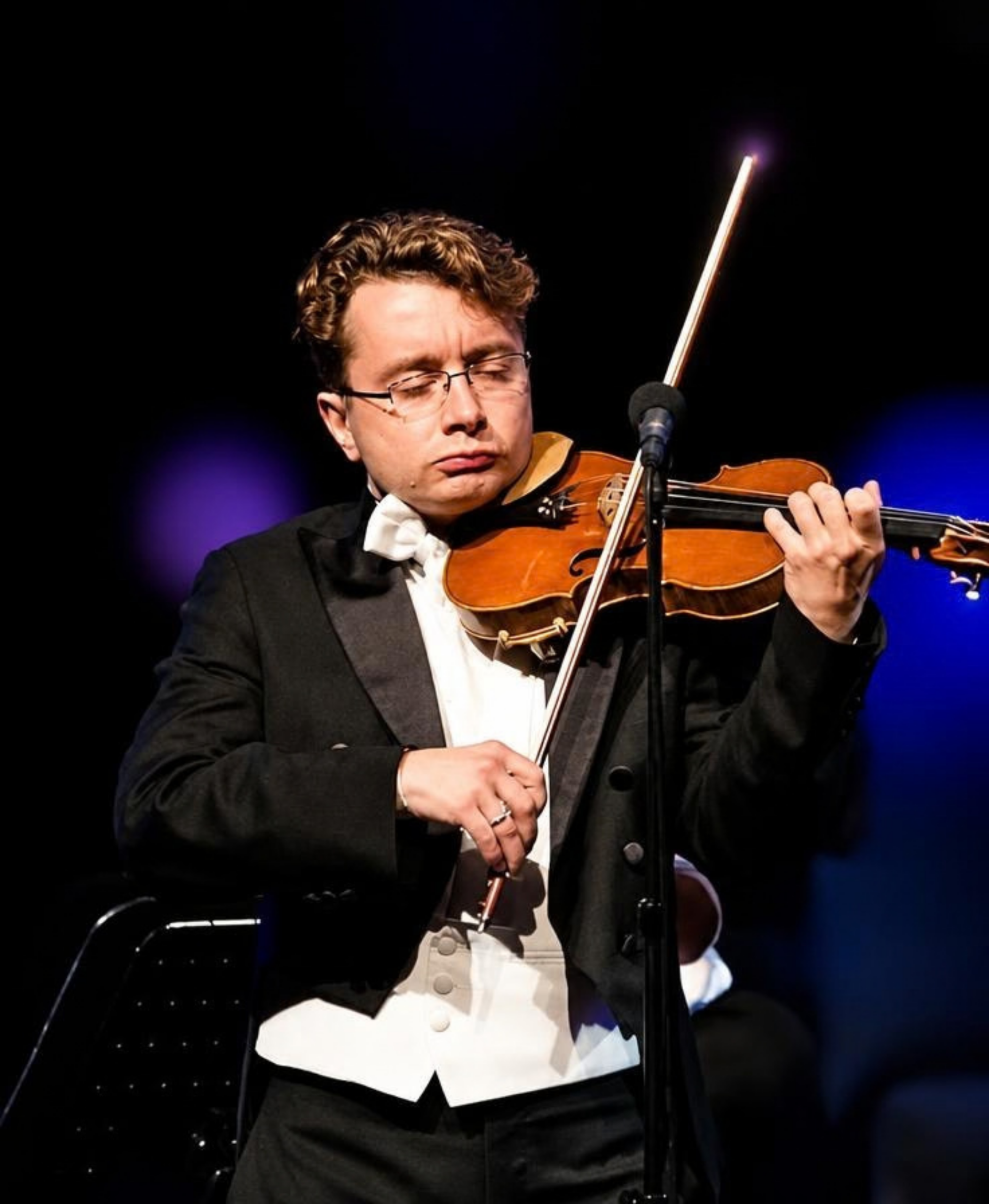
Serving as the prologue to Bolotny’s Echoes on Ukrainian Themes cycle, the piece deliberately steps away from the acoustic warmth and virtuoso display one might expect from a concert violinist. Here, the violin becomes something almost industrial—a relentless mechanism grinding forward with cold, repetitive momentum.
That choice immediately changes the role of the instrument. Rather than placing the violin at the centre as a vehicle for expressive virtuosity, Bolotny uses it to create tension. The sound becomes physical, almost machine-like, suggesting something that cannot be reasoned with or stopped. There is no comfortable resolution in that idea, and the music seems to understand that.
Running through this mechanical pulse is the traditional Ukrainian folk song Ой, доле людська (Oh, Human Destiny). Its presence gives the composition an entirely different emotional dimension. The melody is not presented as nostalgic folklore or dressed up in sentimental beauty. Instead, it feels depleted, almost powerless against the machinery surrounding it.
That contrast is where the piece becomes particularly affecting. The folk melody represents something deeply human and ancestral, while the relentless pulse surrounding it feels indifferent to human suffering. Bolotny brings the two together without allowing either to completely overcome the other.
The result is a work shaped by the ongoing war in Ukraine, but notably not through the spectacle of conflict. “Reflections” focuses on what remains after the noise—the solitude, numbness, exhaustion and confrontation with fate. It is grief expressed through restraint rather than melodrama.
That approach also places the piece within Bolotny’s broader artistic development. A Ukrainian-born concert violinist and composer based in the Netherlands, he serves as Assistant Second Concertmaster of the Noord Nederlands Orkest and has studied in Lviv, Kyiv and Vienna. His wider compositions have often explored the relationship between traditional musical heritage and contemporary concert writing, including his Ukrainian Caprices and Little Dutch Rhapsodies.
https://untitled.stream/library/project/98I8z7o69jYEPTqkLBtpQ
But “Reflections” feels like a deliberate departure from virtuosity as spectacle. The technical possibilities of the violin are still there, but they are placed in service of an idea rather than used to impress.
The music leaves you with an unsettling question: what happens to a human voice when the machinery of history becomes too powerful to resist? Bolotny doesn’t answer it. Instead, he lets the violin keep moving—and lets the exhausted melody struggle to survive inside it.
Connect with Sergiy Bolotny on